
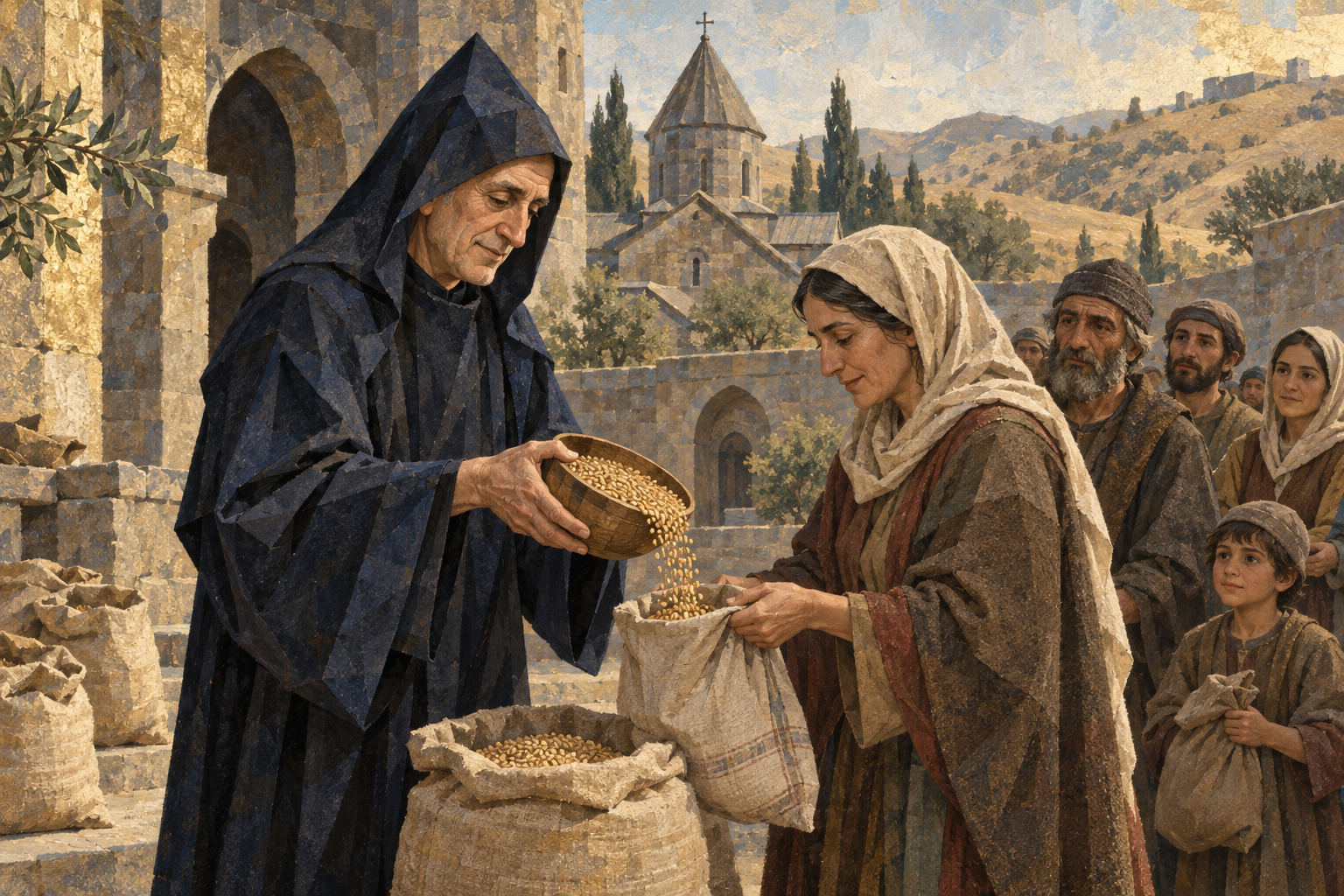

An Armenian legend tells how a learned monk, an angel’s warning, and a simple round bowl helped a community survive seven years of drought.
In a time of lawlessness and uncertainty, Mkhitar, known as “the Beardless,” became an example of integrity and perseverance. He was a vardapet—a learned monk—respected for his honesty, directness, and wide knowledge. Armenian princes welcomed him into their homes, while ordinary people sought his company and counsel.
Yet he fell out of favour with the Catholicos of Caucasian Albania and moved to the ancient monastery of Getik. His work would later become closely associated with Nor Getik, where learning and craftsmanship flourished and the monastery grew into a spiritual centre.
Word of Mkhitar’s work travelled far. Despite the wars that troubled the surrounding lands, theologians and philosophers came from distant places to meet him.
After years devoted to learning and service, Mkhitar began to feel that the time had come to rest. But one night, an angel appeared to him in a dream.
“Listen carefully, Mkhitar,” the angel said. “For seven years, your harvests will be plentiful. Store grain, for the seven years that follow will bring drought.”
“People are right,” Mkhitar thought. “One should not depart before one’s time.”
For the next seven years, the monastery gathered grain and set it aside. Harvest after harvest, its reserves grew.
Then the rains stopped.
The fields no longer yielded enough food, and hunger threatened the people. Mkhitar made a round bowl, called a “gush,” and used it to measure out the stored grain. Each person received an equal share.
With patience and careful stewardship, he made the supplies last throughout the seven years of drought. The grain was shared fairly, sustaining the community until the difficult years had passed.
According to the legend, it was this humble bowl that gave Mkhitar the name Gush, or Gosh. Nor Getik became known in his honour as Goshavank—the Monastery of Gosh.
The story remembers a scholar whose wisdom took a practical form: preparing for hardship and making sure that everyone received their share.
0 Comment