
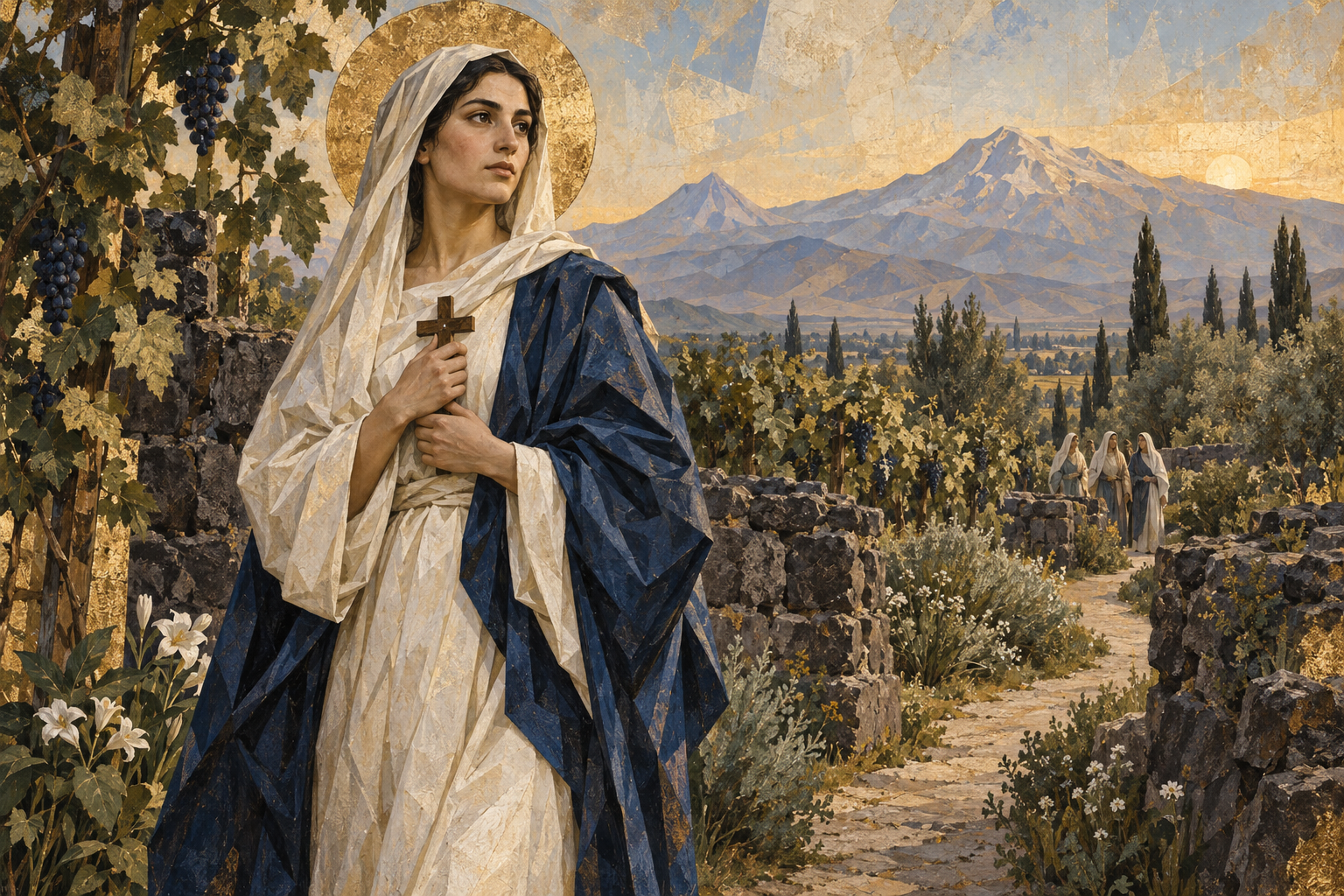

Armenian Christian tradition tells the story of Hripsime, a young woman whose devotion remained unshaken in the face of imperial power.
According to the legend, the Roman emperor Diocletian, a fierce persecutor of Christians, wished to choose a bride. He sent painters throughout his empire to bring him portraits of its most beautiful women.
Before long, he learned of Hripsime, a young Christian living in a religious community in Rome. When he saw her portrait, he ordered preparations for their wedding.
But Hripsime had dedicated her life to Christ and taken a vow of chastity. Rather than submit to the emperor’s wishes, she fled Rome with thirty-six fellow nuns.
Their journey took them to Alexandria and then to Jerusalem. From the Holy Land, guided, according to the tradition, by the Blessed Virgin Mary, they continued to Armenia. They reached Vagharshapat and found shelter among its gardens, supporting themselves by spinning yarn and making strings of beads.
Diocletian, however, had not abandoned his pursuit. He sent a letter to Armenia’s King Trdat, demanding that the women be found. The others were to be executed, while Hripsime was to be sent back to him.
Soon, guards surrounded their refuge. Courtiers, nobles, and townspeople gathered to see the young woman whose beauty had drawn an emperor’s attention.
Trdat sent servants with a gilded litter to bring her to the palace. When she refused to leave, they took her by force.
On seeing Hripsime, the king became determined to possess her himself. He tried to force himself upon her, but, as the story tells it, God gave her the strength to resist. She struggled free, tearing away his crown and royal garments and leaving him exhausted on the floor. Then she walked fearlessly past the astonished courtiers and returned to her companions.
Her escape did not bring safety. Guards and executioners came for the women. Hripsime and her spiritual sisters were put to death for refusing to submit and remaining faithful to Christianity.
The tradition continues with Trdat’s illness, repentance, and eventual conversion to the faith he had persecuted.
Hripsime’s memory endured. Today, Saint Hripsime Church in Vagharshapat bears her name. The surviving church dates to AD 618, centuries after the events described in the legend.
At the heart of her story is a young woman’s resolve to remain faithful to her beliefs, even when confronted by the power of emperors and kings.
0 Comment