
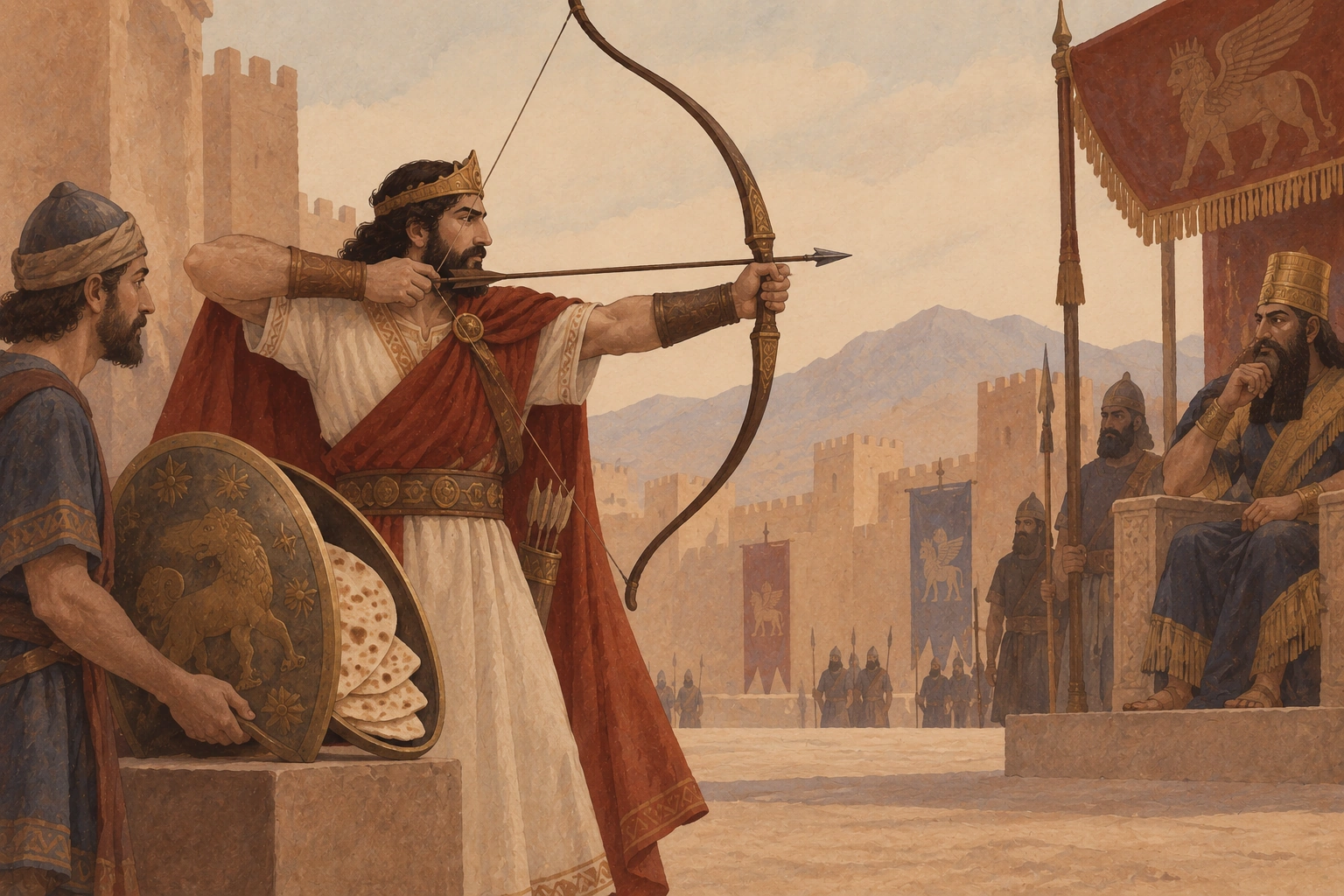

It happened that during one of the battles, King Aram was captured by the Assyrian ruler Nebuchadnezzar. Since this did not yet mean an unconditional victory of one over the other, Nebuchadnezzar set a condition:
“For ten days you will eat no bread. On the eleventh day, you will compete with me in archery. If you win, it will mean that you are stronger than I am, and I will set you free.”
Aram thought all night, and the next morning he asked that the most beautiful shield be brought to him from the Armenian army stationed near the borders of Assyria.
Nebuchadnezzar did not object, and the Assyrian king’s messengers went to the Armenians and delivered Aram’s request.
All night, the king’s servants wondered why he needed a shield. Then they understood. They hid thin lavash inside it and handed the shield to the messengers.
None of the Assyrians had ever heard of lavash. Who could have imagined that bread could be hidden beneath the copper covering of a shield?
When Aram saw the shield, he merely shook his head.
“No, this one is not good enough. Could you bring me another?”
And so, every day until the agreed period had passed, the messengers rode to the border and again and again brought Aram a new shield — with lavash hidden inside.
On the eleventh day, Aram and Nebuchadnezzar went out to the archery ground.
Nebuchadnezzar was certain that, deprived of bread, Aram had lost his spirit and strength.
But then came the surprise.
Aram won the contest and returned to his homeland with honor.
Lavash had saved him.
After returning home, the king ordered that from that time onward, lavash should be baked throughout Armenia instead of other kinds of bread.
0 Comment