
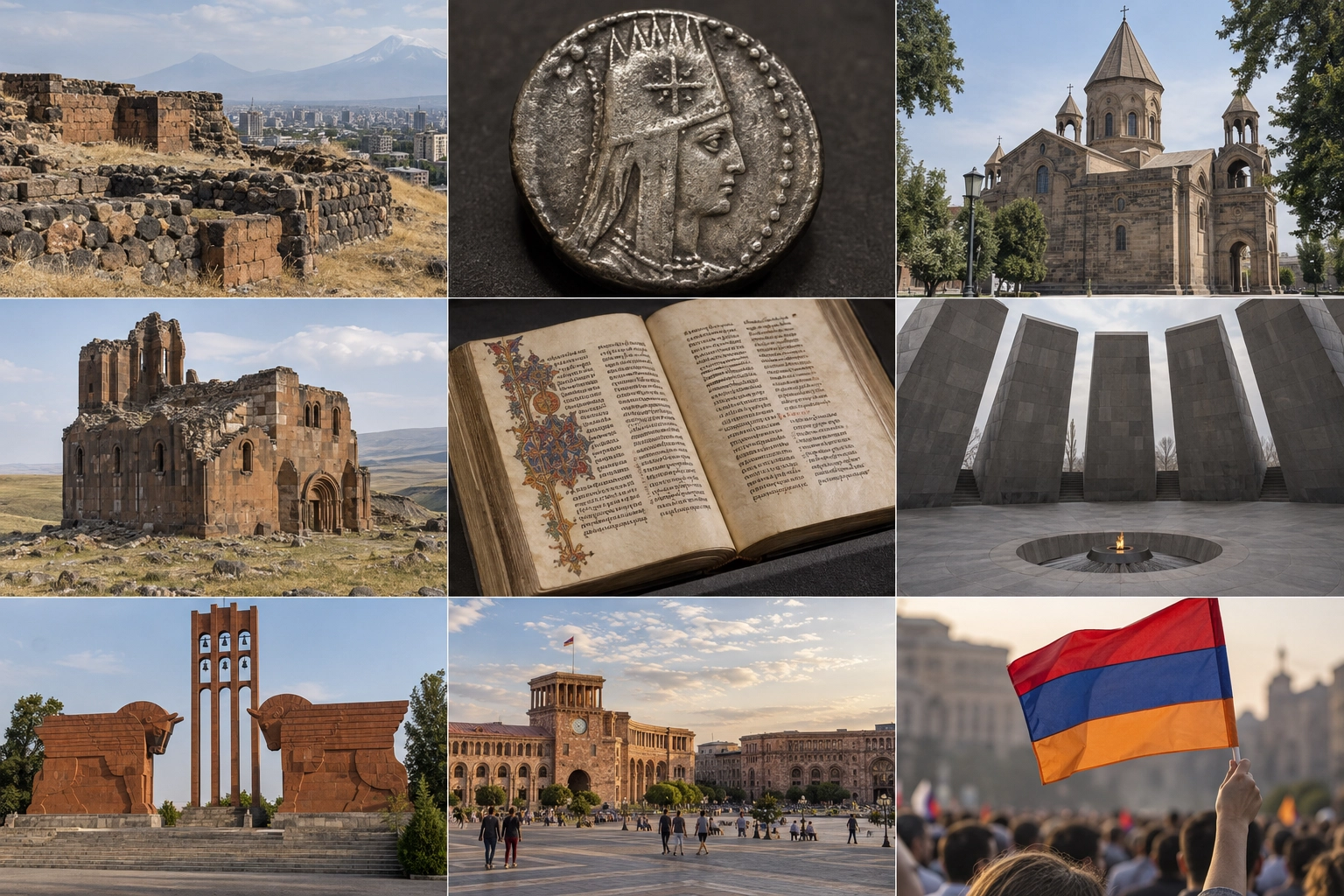

A first impression of Armenia often begins with its landscapes: mountains, stone churches, old fortresses, and cities. Behind these sights is a history that connects different eras through kingdoms, faith, craftsmanship, and the work of rebuilding after hardship.
One of the earliest chapters belongs to the Kingdom of Van, also known as Urartu, which developed in the Armenian Highlands. In 782 BC, King Argishti I founded Erebuni Fortress. His cuneiform inscription preserves the memory of that event, and Erebuni’s foundation is considered the starting point of Yerevan’s history.
In later centuries, Armenian statehood continued through the Orontid, Artaxiad, and Arsacid kingdoms. During the first century BC, under Tigranes the Great, the Armenian kingdom reached its greatest territorial extent. Alongside these political changes, towns developed as centres of trade and craftsmanship, maintaining connections with neighbouring cultures.
Another major turning point was the adoption of Christianity, traditionally dated by the Armenian Church to AD 301. The new faith gradually found expression in architecture and art. The churches of Etchmiadzin preserve different periods of this heritage.
Among the great centres of medieval Armenia was Ani, the capital of the Bagratid kingdom. In the tenth and eleventh centuries, it flourished as a city of commerce, craftsmanship, and architecture. Its ruins, now in Turkey, also remind visitors that the geography of historical Armenia extends beyond the borders of the present-day Republic of Armenia.
Later centuries brought foreign rule, wars, and displacement. Armenian communities continued their cultural life both at home and abroad. The Armenian Genocide of 1915 devastated people and the heritage they had created. Many manuscripts were lost, while others survived through the efforts of those who carried them to safety.
In 1918, the First Republic of Armenia was established, with Yerevan as its capital. Soviet rule followed in 1920. During the Soviet period, Yerevan expanded considerably, its development shaped by architect Alexander Tamanyan’s master plan.
On September 21, 1991, the people of Armenia voted for independence in a national referendum, opening a new chapter in the country’s history.
For a traveller, this history offers a way to understand the places along the route. The stones of Erebuni, the walls of a medieval church, and the streets of Yerevan each belong to a different period. Around them, everyday life continues, with people working, creating, and adding their own stories to the places they call home.
0 Comment