
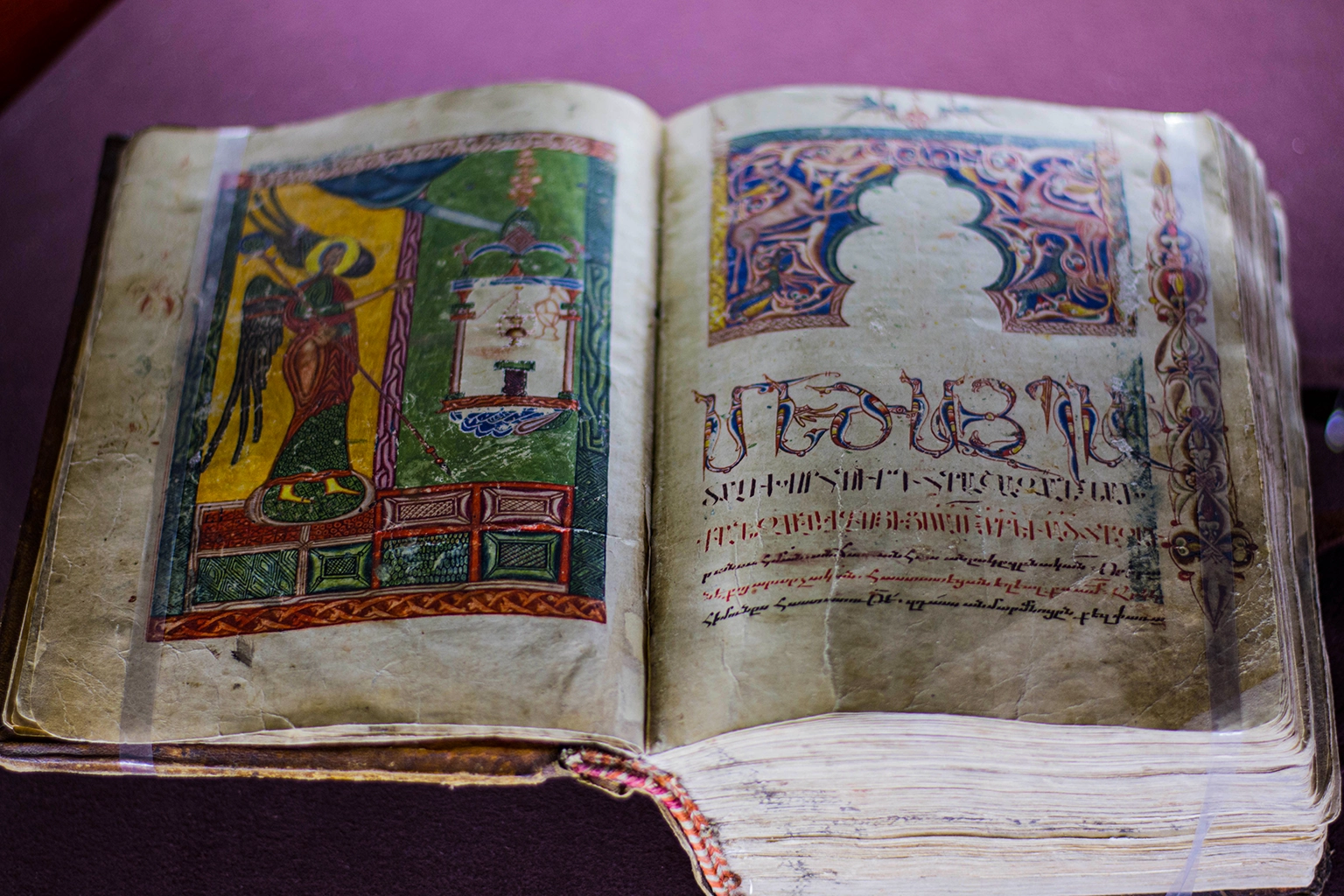
In Armenia, letters appear everywhere: on the pages of books, on church walls, in jewellery, and inside homes. They may be plain and readable or shaped into birds, floral patterns, and elaborate ornaments. Behind this familiar presence is a story that began more than sixteen centuries ago.
In AD 405, Mesrop Mashtots created the Armenian alphabet. Designed to represent the sounds of the Armenian language, its letters gradually became one of the most recognisable expressions of Armenian cultural identity.
The creation of the alphabet opened the way for Armenian literature and translation to develop. People could record stories, share knowledge, and preserve the intellectual life of their time in their own language. The fifth century became a turning point in Armenian written culture.
Making a manuscript required patient work. A scribe copied the text, an illuminator decorated the pages, and a bookbinder prepared the binding. Every part of the book could reveal the skill of its makers, from the shape of the letters to the colours and ornaments in the margins.
These books preserved religious writings alongside works on history, medicine, philosophy, and other subjects. The manuscripts displayed at the Matenadaran in Yerevan reveal the range of knowledge and artistic work that developed around the written word. Its foreign-language collections also tell of exchanges between cultures.
Preserving this heritage was not always peaceful work. Many manuscripts disappeared during wars and displacement. Others survived because people carried them to safety and entrusted them to institutions where they could be protected. The history of the Matenadaran’s collection is also the history of these rescued books and the people who cared for them.
Armenian letter art remains part of life today. Letters take new forms in embroidery, carpet weaving, jewellery, and sculpture. In 2019, Armenian letter art and its cultural expressions were inscribed on UNESCO’s Representative List of the Intangible Cultural Heritage of Humanity.
While travelling through Armenia, take a moment to look closely at an old inscription or a manuscript page. Even without reading Armenian, you can follow the shapes of the letters, their rhythm, and their decoration. Behind those marks are people who wrote, studied, created, and passed what they knew to the next generation.
0 Comment